Shoot Hunter Gun War
- 4.4
- Rating
- 1.00M
- Installs
- Free
- Price
 Analysis by App-foxy
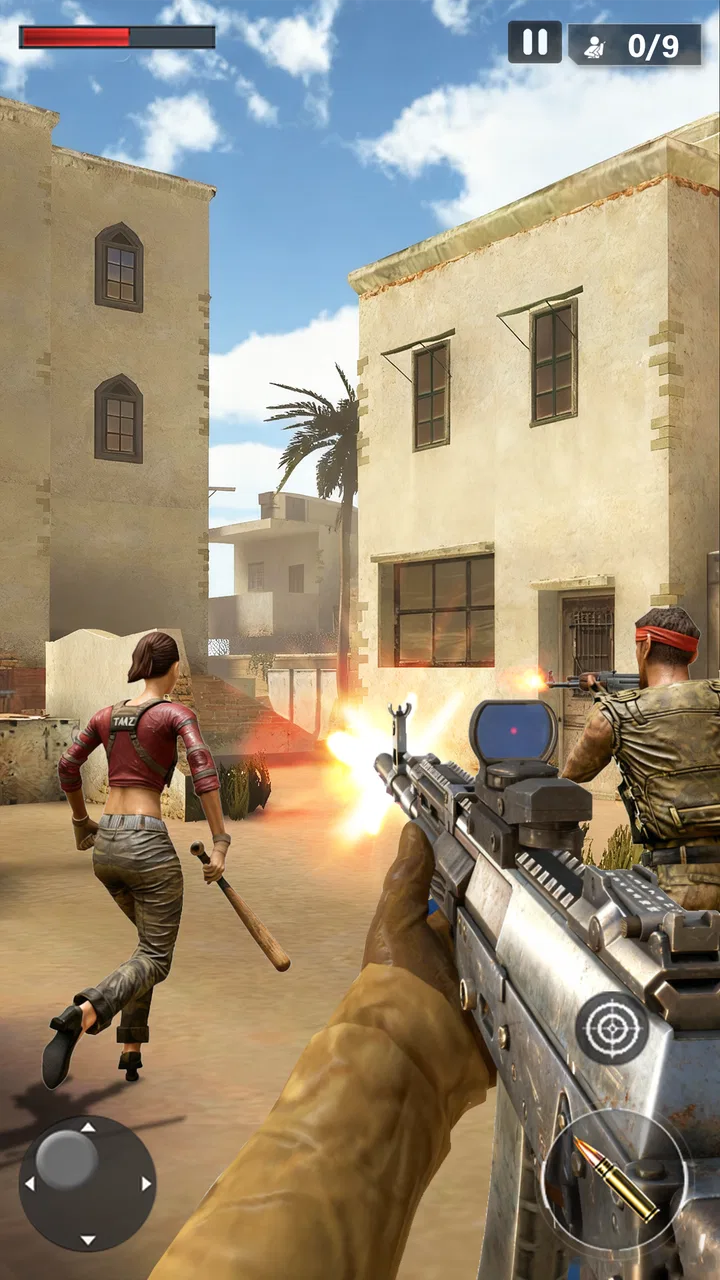
I spent my first sessions with Shoot Hunter Gun War trying to answer a simple question: is this an adventure shooter I would still open after the initial curiosity wears off? Its basic appeal is immediate. You step into a combat-focused experience built around shooting, survival, attacking, and defending, with a mature tone that clearly aims at players who want action rather than a relaxed puzzle or storybook journey.
The game is free to download, which makes it easy to test without committing money at the start. It comes from FPS Shooter Game and sits in the adventure category, although its identity is much more strongly tied to gunplay than to exploration. I found it most appealing in short bursts, especially when I wanted something direct and uncomplicated. The more important question is whether that directness can support a regular habit.
What the first week feels like
The opening appeal comes from how quickly the game communicates its purpose. There is no need to decode a complex premise before getting into the action. The central fantasy is clear: take the role of a combat-ready hunter, handle threats with a firearm, and try to stay alive while completing the immediate objective. That clarity is useful when I only have a few minutes and do not want to spend the whole session managing menus or learning a large fictional universe.
You May Also Like

 Blood Strike: 2.5 Anniversary
Blood Strike’s Loadouts Turn Every Drop Into a Tactical Gamble
A close look at Blood Strike’s custom loadouts: how fast access to signature weapons reshapes its battle royale rhythm, rewards preparation, and narrows the gap between fights.

 Pandora - Music & Podcasts
Pandora’s Music Is Easy to Start, but Harder to Recover
Pandora’s strength is its low-effort path from a seed to a station. Its weak spot is how much confidence it asks you to place in connection, setup, and quiet recovery.

 8 Ball Pool
 Is Built on Rivalries, Rematches, and Routine
A close look at the rivalries, rematches, shared routines, and unanswered safety questions that turn a quick pool match into a persistent mobile community.

 Samsung Music
’s Quiet Strength Is Playing What You Already Own
Its reach comes less from spectacle than from dependable access to a personal library. That simplicity is both the app’s strongest retention engine and its ceiling.

 AccuWeather: Weather Radar
AccuWeather Review: A Quick, Clear Forecast for Everyday Decisions
For everyday plans, the best forecast is the one you can understand quickly. AccuWeather makes rain timing, radar, and local conditions easy to act on, with a few trade-offs.

 Hill Climb Racing
Why Hill Climb Racing Still Turns Crashes Into One More Run
A tiny car, a bumpy hill and one more upgrade: Hill Climb Racing keeps resurfacing because its simple chaos makes every near-miss feel personal.
More From Our News Desk



In my first week, I treated it as a pick-up-and-play title rather than a game demanding a long uninterrupted sitting. That worked well. A brief session can feel worthwhile because the shooting theme gives every encounter an obvious focus. The mature 17+ rating also sets the right expectation: this is not aimed at children, and parents should treat it as an adult-oriented action game rather than a general family download.
The strongest early use case is a spare moment when I want something more active than a casual arcade game but less demanding than a large console-style adventure. I can launch it with a clear idea of what I am there to do. That matters more than it sounds. Many mobile action games bury their main attraction under upgrade screens, collectible systems, or long introductions. Here, the combat premise remains front and center.
That focus is also the first limitation. Players who expect a deep adventure with extensive character development, a broad world, or a carefully paced narrative may find the experience narrower than the category label suggests. I would approach it as a shooting game with an adventure wrapper, not as a story-heavy journey. If your favorite part of an adventure is discovering locations and meeting memorable characters, this probably should not be your first choice.
Who gets the most from the early sessions
I think the best match is someone who likes straightforward firearm action and prefers learning through repeated play instead of reading a long tutorial. It can also suit players who want a free trial before deciding whether a mobile shooter deserves regular storage space. The current version is 1.2.0, and the game supports devices running Android 8.0 or later, so compatibility is worth checking before planning to make it your everyday game.
The first-week experience is less convincing for people who need a strong social layer, a large narrative, or a highly distinctive visual identity to stay interested. I also would not recommend it as a substitute for a full competitive shooter if your priority is a broad multiplayer ecosystem or finely balanced long-term competition. The store summary promises the feeling of joining an elite force and surviving combat, but the lasting value depends on how much enjoyment you personally get from repeating that core loop.
One practical tip helped me judge it more fairly: I played several short sessions at different times instead of forming an opinion from one long launch-day run. A shooter can feel exciting for an hour simply because everything is new. Returning after the novelty has settled reveals whether the aiming and encounter rhythm are satisfying on their own. For this game, that test is especially important because its appeal is concentrated in the action rather than spread across many unrelated systems.
How it compares with familiar mobile alternatives
Compared with a casual shooter, this game presents itself with a more serious combat mood and an adult rating. That can make it feel more focused for players who want a tougher atmosphere. Compared with a large military shooter, however, it is better understood as a compact alternative rather than a complete replacement. The bigger games usually win when you want extensive customization, a broad competitive community, or a constantly changing live-service routine.
Its advantage over those larger alternatives is convenience. A focused game can be easier to return to when I do not want to download a huge package, learn a complicated meta, or spend time preparing for a match. The trade-off is that a narrower design has fewer ways to refresh itself. If the shooting itself does not remain enjoyable, there may not be enough secondary activity to rescue a tired session.
Whether it earns a place after the novelty
After the first-week excitement, I judge a game like this by habit rather than by its opening impression. Does it fit naturally into an ordinary day? For me, the most realistic scenario is a short evening break after work or a few minutes while waiting somewhere. I would not build an entire gaming night around it, but I can see why a player might keep it installed for quick action when a slower adventure feels like too much commitment.
The free entry point supports that role. A player can try the combat loop, decide whether the controls and pacing feel comfortable, and only then consider spending anything. In-app purchases range from $0.99 to $39.99 per item, so I would set a personal spending limit before browsing purchase options. The important habit is to judge the game first with the free experience, rather than assuming that buying something will solve boredom or make the core shooting more enjoyable.
That advice is particularly relevant for a title whose value is based on repetition. If I enjoy the basic encounter rhythm, optional spending may feel like a convenience. If I do not enjoy it, purchases are unlikely to change the fundamental reason I am losing interest. I prefer to keep the decision separate: first ask whether I want to play another session, then decide whether any paid item is genuinely useful to my routine.
The maintenance cost of keeping it installed
The maintenance burden is not just about updates. It is also about attention. A game deserves permanent space on my phone when it is easy to return to, does not demand more time than I have, and gives me a reason to play beyond the first few attempts. Shoot Hunter Gun War has a low mental entry cost because the objective is easy to understand. That is a real strength for a mobile game.
At the same time, a focused shooter can require more personal maintenance than it first appears. I need to notice whether sessions are still fun or whether I am opening it automatically out of habit. I also need to keep my expectations realistic. If I install it hoping for a broad adventure, I may constantly feel that something is missing. If I install it for direct shooting action, the decision becomes much clearer.
My suggested routine is simple. Keep it installed if it regularly fills a specific gap, such as a short action break, and remove it if I repeatedly launch it without finishing a satisfying session. That sounds obvious, but it prevents a common mobile-gaming problem: keeping several similar shooters available and never giving any of them enough attention to discover which one actually fits.
The audience size suggests that the game has reached more than one million installs, while its average rating is 4.4 from around twenty-three thousand ratings. Those figures indicate substantial interest, but they do not decide whether it belongs on my particular phone. A popular action game can still be the wrong match for someone who wants a narrative adventure, and a modestly featured game can still be perfect for someone who values quick, readable combat.
Where fatigue is most likely to appear
The first source of fatigue is repetition without a strong personal goal. Shooting enemies can remain satisfying, but the loop needs to feel meaningful to me. Once I understand the basic premise, I may start noticing whether each session offers a fresh challenge or simply asks me to perform the same kind of action again. I would pay attention to that feeling during the second and third weeks, not just during the initial download.
The second source is the gap between the adventure label and the actual reason to play. If I want exploration, story progression, or a world that rewards curiosity, I may feel under-served. The game’s identity is clearest when I treat it as a combat-first experience. That is not a flaw by itself, but it becomes a problem when the category creates expectations the moment-to-moment play does not satisfy.
The third source is purchase pressure. Because individual in-app items can cost as much as $39.99, I would avoid making an emotional purchase after a frustrating session. A better approach is to play for several days, note what repeatedly causes irritation, and ask whether the free game is already enjoyable without spending. If the answer is no, I would move on rather than trying to buy my way into a better impression.
There is also a device-fit issue that many players overlook. A shooter can be technically compatible and still feel uncomfortable if the screen, controls, or performance do not suit the way I hold my phone. I would test it with the device I actually use for daily gaming, not assume that a newer or larger phone experience will translate perfectly. That is another reason the free entry matters: the trial should include real play, not just installation.
Small habits that improve the evaluation
I found three useful ways to decide whether the game has lasting value. First, separate “I have time” from “I want this specific game.” Opening it only when bored can make almost any shooter feel interchangeable. I would ask whether the combat itself is what I want before launching.
Second, alternate short and longer sessions during the trial. Short sessions reveal convenience; longer ones reveal fatigue. A game that works only for a few minutes may still be worth keeping as a pocket distraction, but I would not mistake that for deep replay value.
Third, review spending as part of the experience rather than as an afterthought. Since the game is free but includes paid items, I would decide in advance whether I am comfortable spending and what would count as worthwhile. This keeps the purchase decision tied to actual use instead of excitement, frustration, or pressure to progress.
These habits also clarify who should skip it. I would pass if I wanted a rich narrative campaign, a family-friendly rating, or a shooter whose main attraction is a large, evolving online community. I would also skip it if I already have several installed games that offer the same quick-action role and I am not looking for another variation on that routine.
My long-term verdict
My lasting impression is positive but carefully limited. Shoot Hunter Gun War succeeds when I use it as a direct, mature mobile action game that I can pick up without much preparation. The free download makes experimentation easy, and the first sessions have enough immediate purpose to appeal to players who want to lock into combat rather than wander through a complicated adventure.
It does not automatically earn permanent space just because it is accessible. Its long-term position depends on whether the shooting remains satisfying after the first-week novelty fades. The game has fewer obvious escape routes if I become tired of its central loop, so I would keep it installed only if it fills a clear role in my routine. For me, that role is a short action break, not a primary adventure game.
The developer, FPS Shooter Game, has chosen a straightforward identity, and that makes the recommendation easy to explain. If you want a free-to-start, adult-oriented shooter with an adventure framing, it is worth trying on a compatible device. Give it enough sessions to test repetition, avoid treating purchases as a solution to boredom, and compare it honestly with the larger shooters already available to you.
My final recommendation is therefore conditional but genuine: keep it for focused bursts, not for promises it does not need to make. The game earns a place when its simple combat gives your day a useful, enjoyable break. If you need deep exploration, extensive social play, or a constantly renewing long-term system, another option will serve you better. For the right player, though, its restraint is exactly what makes it convenient.
FAQs for Shoot Hunter Gun War
01What is Shoot Hunter Gun War?
Shoot Hunter Gun War is an action shooting game focused on fast-paced missions against enemy targets. Players move through different environments, aim with a variety of firearms, and complete objectives while trying to survive incoming attacks. The game is designed for short, accessible sessions, making it suitable for users who enjoy straightforward first-person or third-person shooting gameplay on mobile devices.
02Is Shoot Hunter Gun War free to download and play?
Shoot Hunter Gun War is generally available as a free download, allowing players to install the game without paying an upfront purchase price. However, free mobile games may include advertising, optional in-app purchases, or other monetization features. Before downloading, users should check the current store listing for details about paid items, supported devices, permissions, and whether an internet connection is required for all features.
03Does Shoot Hunter Gun War require an internet connection?
The basic missions in Shoot Hunter Gun War may be playable without a constant internet connection, which is convenient when traveling or when mobile data is limited. Nevertheless, advertisements, updates, online services, and certain game features can require connectivity. Availability may also differ between Android and iOS versions, so it is best to test the game after installation and review its store requirements.
04What gameplay features and controls does Shoot Hunter Gun War offer?
The game centers on aiming, shooting, moving through combat areas, and completing mission objectives. Its mobile controls typically use on-screen buttons or touch gestures for movement, targeting, and firing, so new players may need a few minutes to adjust their sensitivity and layout. Progression can include new weapons, tougher enemies, and increasingly demanding stages as missions advance.
05Is Shoot Hunter Gun War suitable for children?
Shoot Hunter Gun War contains weapon-based combat, shooting, enemy attacks, and action violence, so it may not be appropriate for younger children. Parents should check the age rating shown on Google Play or the App Store, as ratings and content descriptions can vary by region and platform. It is also worth reviewing advertising and in-app purchase settings before allowing children to play.
Pros
- Fast-paced shooting matches that are easy to start and play.
- Wide selection of weapons keeps combat varied and engaging.
- Simple controls make aiming and movement accessible on mobile devices.
- Offline play is useful when you have limited or no internet access.
- Short missions fit well into quick gaming sessions.
Cons
- Frequent ads may interrupt gameplay
- especially between missions.
- Weapon upgrades can require substantial grinding or in-game purchases.
- Enemy behavior may feel repetitive after extended play.
- Graphics look dated compared with newer mobile shooting games.
- Limited multiplayer features reduce long-term replay value.

Shoot Hunter Gun War
Gallery